
Why TCO Matters More Than Purchase Price
Purchase price is the most visible number in a procurement decision - and often the least informative. Total Cost of Ownership reframes hardware investment around the costs that actually accumulate over a product's working life.
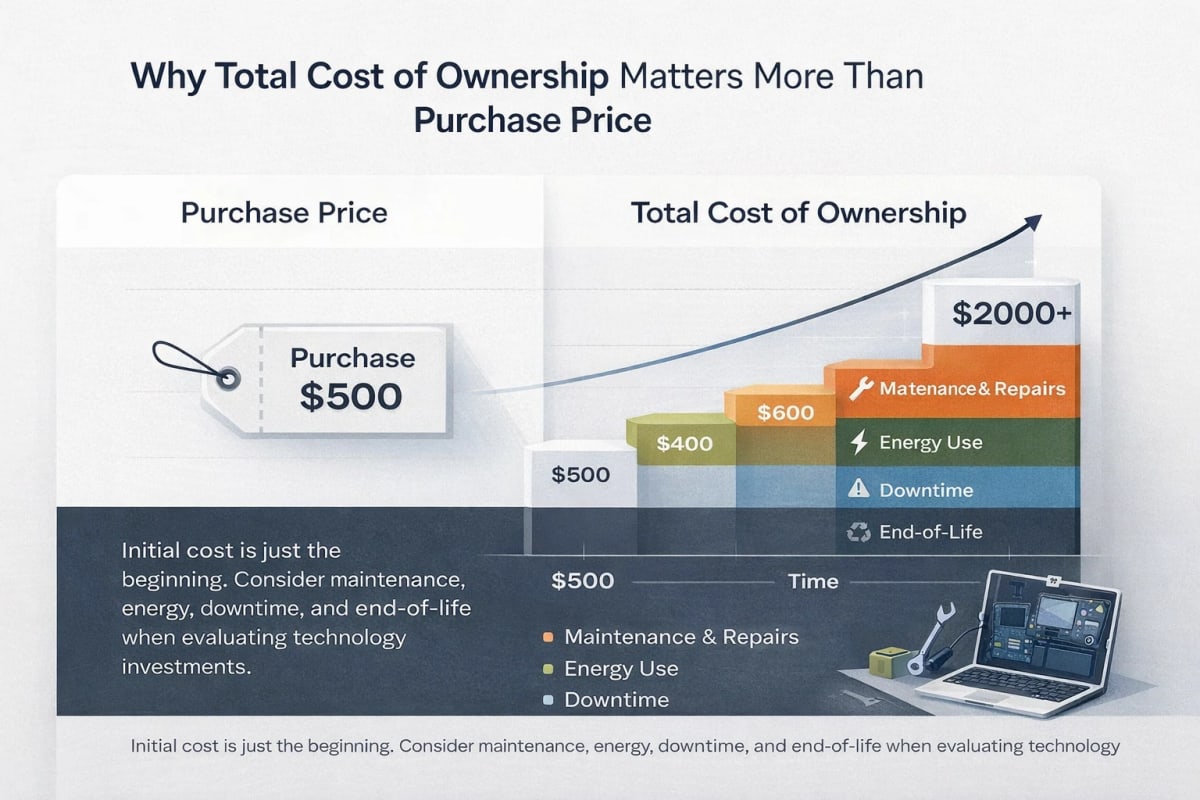
What Repairability and TCO Actually Measure
- Maintenance and service contracts.
- Energy consumption across the deployed lifetime.
- Reliability, MTBF, and downtime cost.
- Repairability and the cost of spare parts.
- Replacement cycles driven by obsolescence or compliance changes.
Where Procurement Teams Lose Money
Most TCO leakage happens in three places: choosing components nearing end-of-life, ignoring energy efficiency in always-on hardware, and underestimating the cost of forced replacements when a part fails out of warranty.
Each of these is preventable with data - but only if that data is attached to the Electronics Bill at decision time, not surfaced in a quarterly review. Teams preparing for ESPR and DPP compliance are increasingly prioritizing lifecycle intelligence earlier in procurement.
Making Component Lifecycle Visibility Operational
TCO becomes useful when it is computed automatically per component and rolled up to the Bill of Electronic Product. That is the level of resolution at which sourcing, design, and finance can finally have the same conversation.
Modern sourcing teams are increasingly moving toward data-driven electronics compliance to reduce hidden lifecycle and redesign costs.
Bring this clarity to your Electronics Bill
Selectronyx scores every component for compliance, repairability, and lifecycle risk - automatically.
Open the App