
The EU Regulatory Super-Cycle: ESPR, DPP & CSRD for Your Electronics Bill
Most procurement teams are preparing for one regulation. The EU has passed four. ESPR, the Digital Product Passport, CSRD, CSDDD and Right to Repair together represent the most significant shift in electronics procurement obligations since RoHS - and the data they require lives in your Electronics Bill.
There is a regulatory assumption buried inside most hardware procurement workflows: that compliance is a single-gate check. You verify RoHS. You confirm REACH. You tick the boxes and move forward. That model no longer describes reality.
The European Union has passed a coordinated suite of hardware-related regulations over the past four years that, taken together, constitute the most significant shift in electronics procurement obligations since RoHS came into force in 2006. ESPR. The EU Digital Product Passport. CSRD. CSDDD. Right to Repair. Each one is individually significant. Together, they represent a structural change in what it means to source components responsibly.
The EU has not passed a series of unrelated regulations. It has passed a single framework for supply chain transparency, implemented across several directives. The underlying data requirement is the same across all of them: visibility into what your components are, where they come from, and what they cost beyond the purchase price.
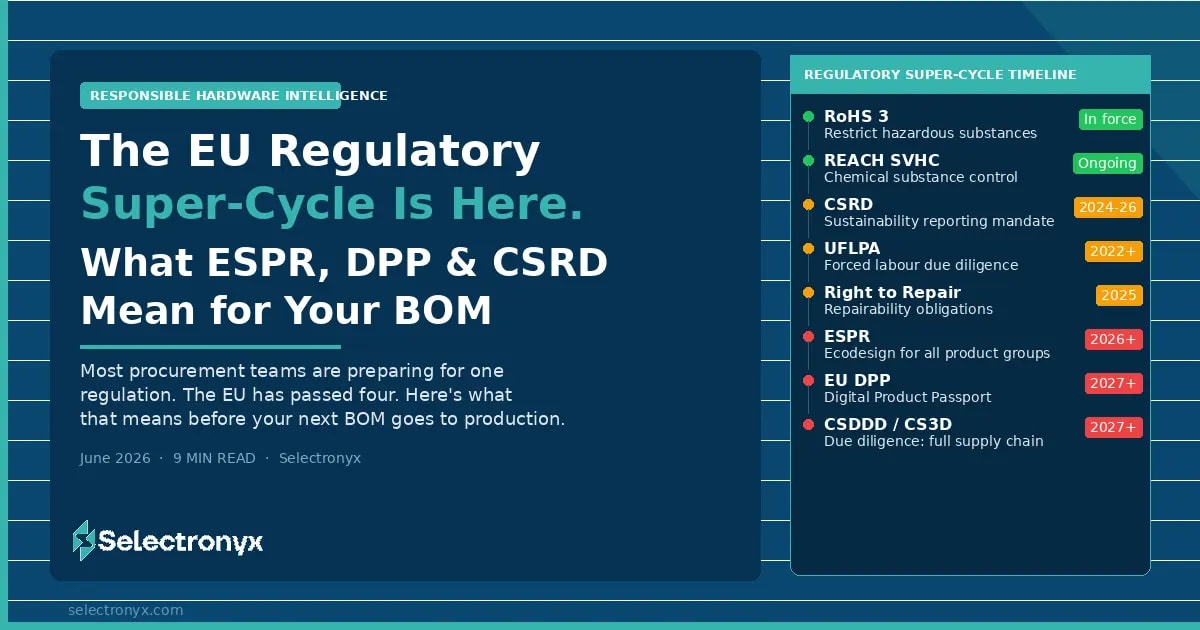
The Regulatory Landscape: What Has Actually Passed
- RoHS 3 (2011/65/EU) - In force. Restriction of hazardous substances; compliance documentation required per product.
- REACH SVHC - In force. Substances of Very High Concern must be declared above 0.1% by weight in articles.
- UFLPA (2022+) - In force. US rebuttable presumption that goods from Xinjiang are made with forced labour unless proved otherwise.
- CSRD (2024-26) - Transitional. Large companies must report Scope 1, 2 and 3 emissions, including purchased goods.
- Right to Repair (2025) - In force. Spare parts, repair information and diagnostic tools must be available for a defined period.
- ESPR (2026+) - Incoming. Mandatory performance thresholds for durability, repairability, recyclability and material efficiency across virtually all product categories.
- EU Digital Product Passport (2027+) - Incoming. A machine-readable record accompanying each product, containing sustainability, compliance and lifecycle data.
- CSDDD / CS3D (2027+) - Incoming. Identify, prevent and remedy adverse environmental and human rights impacts across the full supplier network, not just Tier 1.
ESPR: The Ecodesign Regulation That Changes Component Selection
The Ecodesign for Sustainable Products Regulation replaces the 2009 Ecodesign Directive with one that covers virtually all physical goods placed on the EU market. The first wave of delegated acts covers textiles, electronics, furniture and steel.
If your product contains components that fail ESPR performance thresholds - components that cannot be replaced, that contain substances incompatible with recyclability, or that have documented reliability deficiencies - those components will require substitution before your product can be placed on the EU market. This is not a future audit risk. It is a present component selection decision.
- Minimum repairability scores and spare part availability obligations.
- Recyclability content thresholds and recyclability design requirements.
- Restrictions on substances that impede repairability or recyclability.
- Minimum reliability and durability performance requirements.
- Data availability obligations feeding directly into the Digital Product Passport.
What ESPR Demands from Repairability and FairSpec's Four Pillars
Repairability is now a mandatory product attribute under ESPR - mapping directly to FairSpec's replaceability, spare part availability and design-for-disassembly signals. Reliability and durability are ESPR performance thresholds, and components with documented high failure rates face increasing regulatory scrutiny.
Sustainability under ESPR covers material composition, recyclability, restricted substances beyond RoHS/REACH scope, and energy consumption during manufacture. Total Cost of Ownership incorporates the lifecycle cost factors ESPR makes explicit: repair costs, replacement frequency, end-of-life processing and the cost of potential non-compliance.
The Digital Product Passport and Component Lifecycle Visibility
The DPP is the mechanism through which ESPR and other regulations become verifiable - a structured, machine-readable data record accompanying a product through its lifecycle, accessible via QR code, RFID or similar. Battery DPPs apply from 2026; electronics phase in from 2027 onwards.
The DPP is not a compliance certificate. It is a data architecture. Companies already implementing data-driven electronics compliance workflows will be significantly better prepared for future reporting obligations.
- Material composition and substance declarations (RoHS, REACH, SVHC).
- Repairability information: spare parts, repair manuals, disassembly instructions.
- Lifecycle status: expected operational lifespan, end-of-life handling.
- Supply chain information: country of origin, supplier declarations, certifications.
- Carbon footprint data per product unit, traceable to manufacturing origin.
CSRD: Component Selection Becomes a Reporting Decision
CSRD requires large EU companies to report environmental and social impacts. The critical point for hardware procurement is Scope 3 - indirect emissions across the value chain, including purchased goods. For electronics manufacturers, the carbon embedded in the components they purchase is a material Scope 3 line item.
Most companies currently have no component-level carbon data. They may have corporate-level sustainability reports from Tier 1 suppliers, but these do not provide the granularity required for accurate Scope 3 reporting. Under CSRD, that gap becomes a reporting deficiency.
- The carbon intensity of each component's manufacturing origin.
- Whether the supplier has documented, verifiable carbon data or relies on industry averages.
- How the aggregate carbon footprint of the Electronics Bill compares to alternatives.
- Whether component-level carbon data is available in a format that feeds Scope 3 reporting.
CSDDD: Due Diligence Beyond Tier 1
CSDDD extends supply chain oversight to the full depth of the supplier network. Large companies must identify, assess, prevent and remedy adverse environmental and human rights impacts in their suppliers' suppliers - foundries, substrate manufacturers and raw material processors.
CSDDD does not require perfection. It requires documented due diligence: a defensible process for identifying and addressing risks as they become known. Companies with structured, data-backed sourcing processes and audit trails will be in a substantially stronger position than those whose procurement rationale is undocumented.
Right to Repair: Already In Force
While ESPR and the DPP attract attention as future obligations, the EU's Right to Repair regulation is already in force for smartphones, tablets, laptops and household appliances, with scope expanding over time.
- Spare parts available at reasonable cost for a defined period after market release.
- Repair manuals and technical documentation provided to independent repairers.
- No software locks or design features that prevent independent repair.
- Diagnostic tools available on fair, reasonable and non-discriminatory terms.
One Data Problem and Responsible Hardware Intelligence
These are not five separate compliance programmes requiring five separate data collection exercises. They are five regulatory expressions of a single underlying question: Can you prove, with traceable data, that the hardware decisions you made were responsible ones?
The answer lives in your Electronics Bill. Not in a sustainability report. Not in a legal filing. In the component-level data that backs every sourcing decision your team makes. Organizations already using data-driven electronics compliance workflows are adapting significantly faster to ESPR and DPP obligations.
Procurement teams evaluating Total Cost of Ownership and repairability risk earlier in sourcing are reducing downstream redesign exposure.
- Repairability → ESPR delegated acts, Right to Repair, DPP repair documentation.
- Reliability → ESPR durability thresholds, product liability, warranty cost.
- Sustainability → CSRD Scope 3, REACH SVHC, ESPR material efficiency, DPP carbon data.
- Total Cost of Ownership → CSDDD due diligence trail, ESPR lifecycle cost, CBAM carbon price exposure.
Bring this clarity to your Electronics Bill
Selectronyx scores every component for compliance, repairability, and lifecycle risk - automatically.
Open the App